- Entry and visas
- Money and costs
- Health and insurance
- Safety
- Etiquette
- Connectivity and power
- What to pack for an active trip
- Food
- Accessibility and families
Entry and visas
Citizens of many countries may enter Thailand without a visa for tourism for a limited period; others can apply online for an e-visa. The permitted length of stay and the list of eligible nationalities have been revised more than once in recent years, and a digital arrival card must now be completed online shortly before travel. Check the current rules with a Thai embassy or the official Thai e-visa and immigration websites before you book, and make sure your passport is valid for at least six months. Airlines may ask for proof of onward travel.
Money and costs
The currency is the Thai baht (THB). ATMs are everywhere except on the smallest islands and in the parks, but most charge foreign cards a fixed fee of around 220 THB per withdrawal, so take out larger sums less often and always choose to be charged in baht. Cards are accepted by hotels, dive shops and larger restaurants; markets, longtails, park gates and village shops are cash only. QR payments are widespread for locals but depend on a Thai bank account.
Thailand remains good value. As a very rough guide, excluding flights:
| Style | Per person per day | What it buys |
|---|---|---|
| Budget | About 1,000–1,500 THB | Guesthouses, street food, buses, one paid activity every few days |
| Mid-range | About 2,500–4,500 THB | Comfortable hotels, restaurants, flights between regions, a tour most days |
| Comfort | 6,000 THB and up | Resorts, private boats and guides, liveaboards |
Activities are the main variable: a half-day climbing course or a boat trip costs roughly 1,000–2,500 THB, a try-dive 2,500–3,500 THB and an Open Water course around 10,000–12,000 THB. Tipping is not obligatory; rounding up, or 50–100 THB for a good guide or boat crew, is appreciated.
Health and insurance
- Insurance. Buy a policy that explicitly covers what you will do — scuba diving (and to what depth), climbing, rafting, trekking — and medical evacuation. Many exclude motorbike accidents without a valid licence.
- Vaccinations. See a travel clinic six to eight weeks ahead; routine vaccinations plus hepatitis A and typhoid are commonly advised. Rabies is present: avoid touching dogs, cats and monkeys, and seek treatment promptly after any bite or scratch.
- Mosquitoes. Dengue fever occurs countrywide, in cities as well as forests, mainly in the rainy season. Use repellent and cover up at dawn and dusk. Malaria risk is confined to some forested border areas; ask your clinic.
- Heat. Drink more than you think you need, add electrolytes on active days and take the middle of the day off from March to May.
- Stomach. Drink bottled or filtered water. Busy street stalls cooking to order are generally a safe bet.
- Hospitals. Private hospitals in Bangkok, Chiang Mai, Phuket and Samui are excellent. Remote islands and parks have clinics only. Recompression chambers serve the main diving areas.
Safety
Thailand is a welcoming country and violent crime against visitors is rare. The real risks are mundane.
- Roads. Thailand has one of the world’s highest road-death rates, and motorbikes account for most of it. See getting around.
- Water. Obey red flags on beaches — rip currents kill swimmers every monsoon season. Wear life jackets on boats, and never swim after drinking.
- Operators. For diving, climbing, rafting and ziplining, choose established companies with good equipment, small groups and safety briefings. Cheapest is rarely best.
- Scams. “The palace is closed today”, gem deals, jet-ski damage claims and rigged taxi fares are the classics. Polite refusal is enough.
- Drugs and vaping. Penalties for drugs are severe. E-cigarettes are illegal to import or possess. Cannabis rules have changed repeatedly; do not assume what is legal.
- Emergencies. Tourist Police: 1155. Ambulance: 1669.
Etiquette
- The monarchy is deeply revered and protected by strict laws. Do not make disrespectful remarks.
- At temples, cover shoulders and knees, remove shoes before entering buildings and never point your feet at a Buddha image. Women should not touch monks.
- The head is sacred and the feet lowly: do not touch people’s heads or step over anyone.
- Greet with a wai (palms together) or a smile. Staying calm and polite solves most problems; raising your voice does not.
- Swimwear is for the beach. Topless sunbathing offends, and southern islands such as Koh Lanta have largely Muslim communities.
Connectivity and power
Tourist SIM cards and eSIMs with generous data are sold at airports and convenience stores; bring your passport to register. Coverage is good except deep in the national parks and on Cheow Lan Lake. Wi-fi is standard in accommodation. Electricity is 220 V; sockets take two flat or two round pins, so most European and North American plugs fit, though an adaptor is worth carrying.
What to pack for an active trip
- Light, quick-drying clothes; one long-sleeved layer for sun, mosquitoes and temples; a fleece for the north from November to February.
- Sandals that can get wet, plus trainers or light trail shoes with grip.
- A dry bag, a small daypack and a refillable water bottle.
- Reef-safe sunscreen, or better, a rash vest. Insect repellent. A basic first-aid kit.
- Your dive certification card and logbook; your own mask if you have one.
- A sarong: towel, cover-up, temple wrap and blanket in one.
Climbing gear, dive equipment and kayaks are all supplied by operators; there is no need to bring your own unless you prefer to.
Food
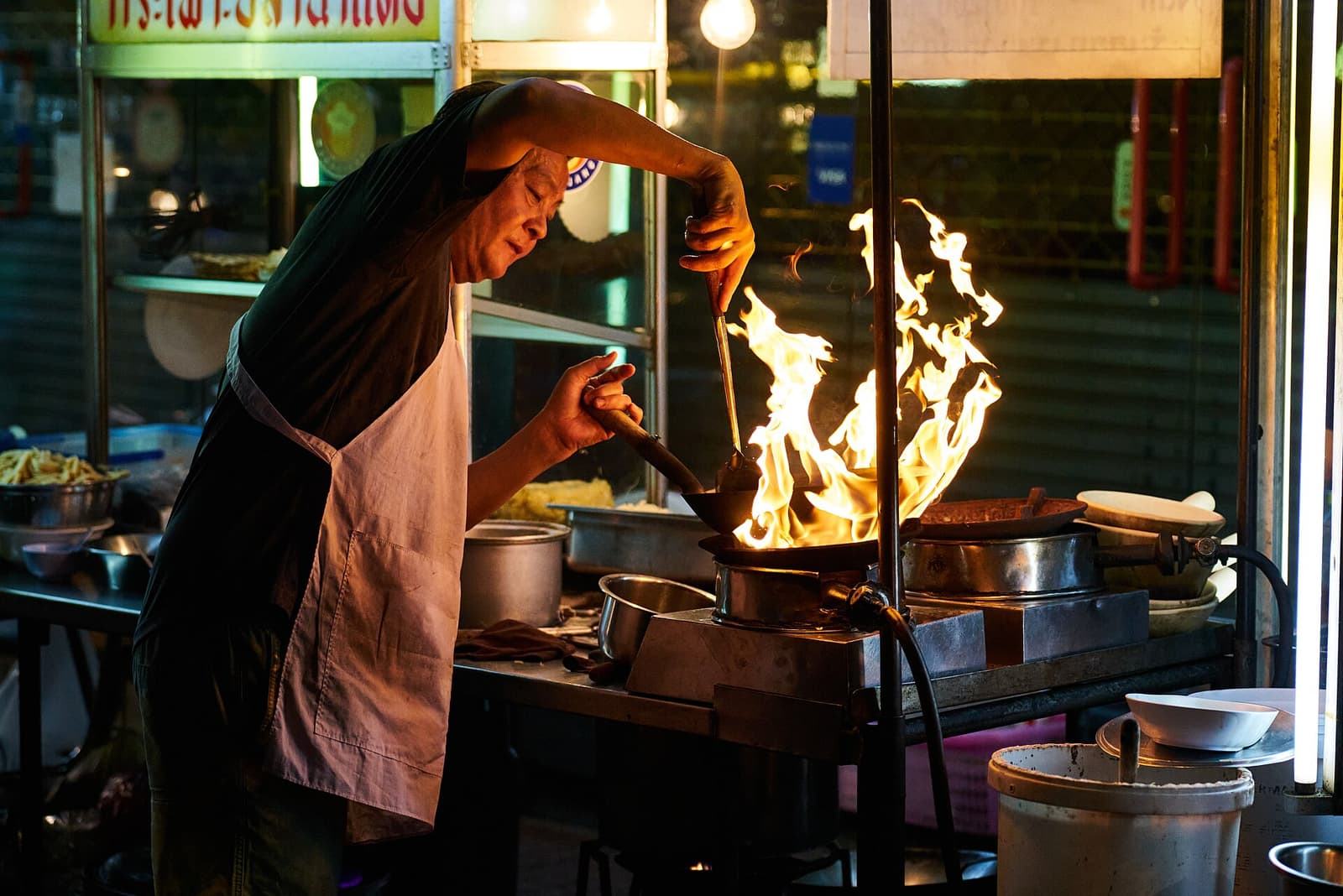
Eating is one of the pleasures of travelling here, and regional cooking is distinct: herbal, mild and pork-rich in the north (khao soi, sai ua); fiery, sour and salty in the north-east (som tam, grilled chicken, sticky rice); fragrant with turmeric, seafood and serious chilli heat in the south. Vegetarians should look for the word jay and yellow flags, and ask for dishes without fish sauce; allergy sufferers should carry a card in Thai. Say mai phet for “not spicy”.
Accessibility and families
Pavements are uneven and step-free access is limited outside modern hotels, malls and Bangkok’s rail stations, though staff are invariably willing to help. Some elephant sanctuaries, big-boat tours and resorts can accommodate wheelchair users with notice. Thailand is easy with children: people are welcoming, food is adaptable and many activities — island-hopping, gentle kayaking, short treks, cycling tours — suit them. See adventures by activity for difficulty levels.